A company Registered in the United Kindom.
Company Number 14443918
Staalbaek Ltd.
Heraldic Achievement
“Vetitum Discepto Est!”
I dispute the prohibition - No Compromise
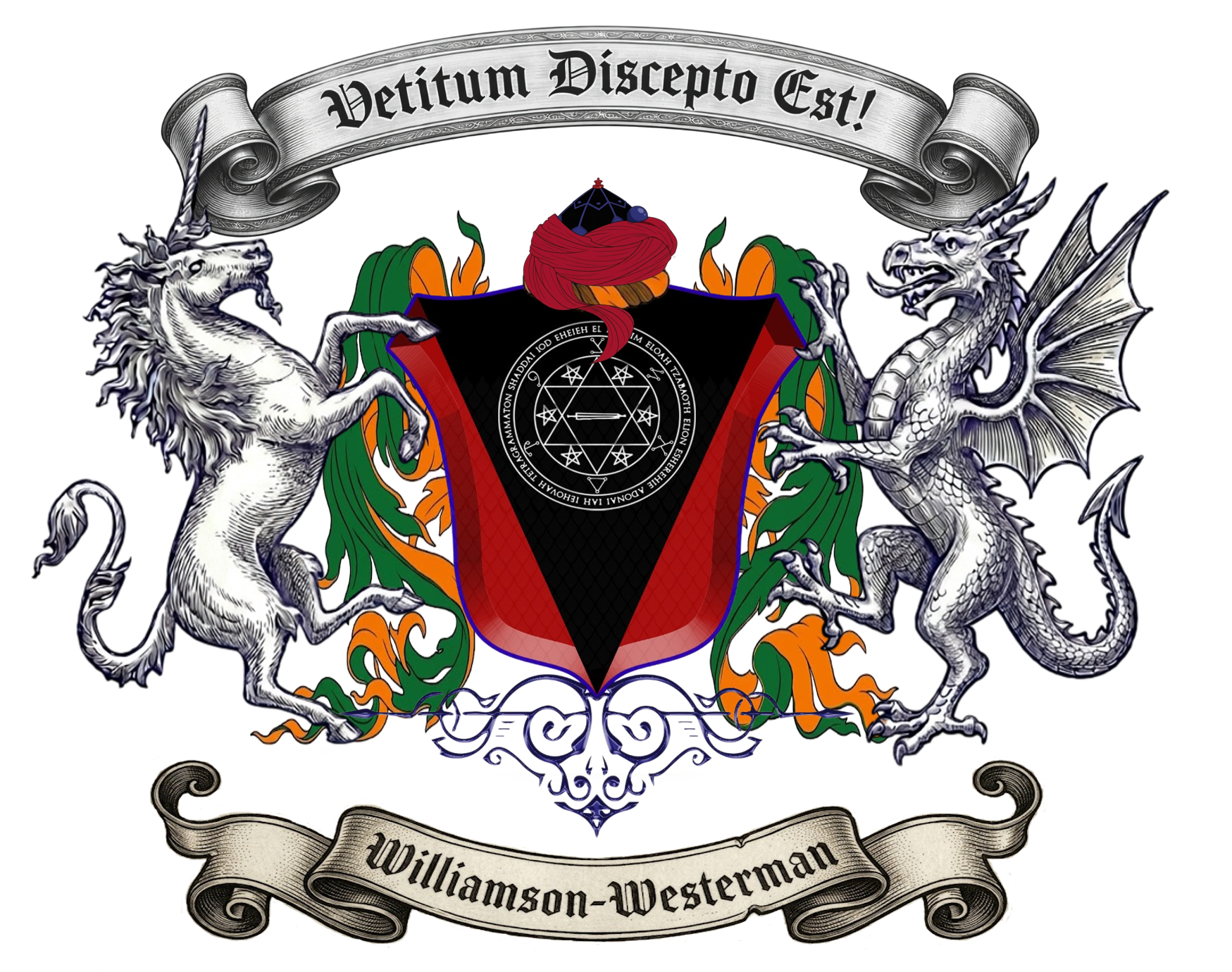
A full heraldic composition, or "achievement," is read in a fixed order — shield, supporters, mantling, crest and helm, compartment, and motto — each element carrying its own meaning. The formal description of the Staalbaek arms is set out below, part by part.
A shield of triangular form, the field Sable, charged with an inverted triangle Gules, overall an alchemical sigil Argent representing the Archangel Zaphchial as depicted in the Lemegeton Clavicula Salomonis. The central charge is scaled in representation, reflecting draconic form and symbolism.
Dexter, a Unicorn Argent rampant, symbolising the Williamson lineage and
the principle of imagination, will, and the maxim that where there is a
Williamson, there is a way.
Sinister, a Dragon Argent rampant, representing the Westerman lineage,
embodying fire and metal, and signifying familial continuity through
daughter and wife.
Mantling Vert doubled Or, tinctured further with elements of Tenné (orange), evoking the wood and striped essence of the Wood Tiger, symbolising forest, vitality, and primal strength. The torse of the same colours (Vert and Tenné) reflects this theme.
Upon a torse is set a helm in the form of a Sharbush, contrary to conventional Western heraldic arrangement wherein the torse rests upon the helm. This inversion signifies distinction and philosophical divergence. The helm represents the teachings of Saladin and denotes the conferred rank of Arim, symbolising wisdom and learned authority.
A decorative base incorporating vegetal and ornamental motifs consistent with the mantling, reinforcing the thematic elements of nature and structured vitality.
“Vetitum Discepto Est!” — “I dispute the prohibition - No Compromise.”
The composition integrates Western heraldic structure with esoteric, alchemical, and Middle Eastern symbolic influences. The colour scheme and charges collectively express a synthesis of lineage (Williamson and Westerman), philosophical doctrine (imagination, discipline, and wisdom), and elemental symbolism (wood, fire, metal).